
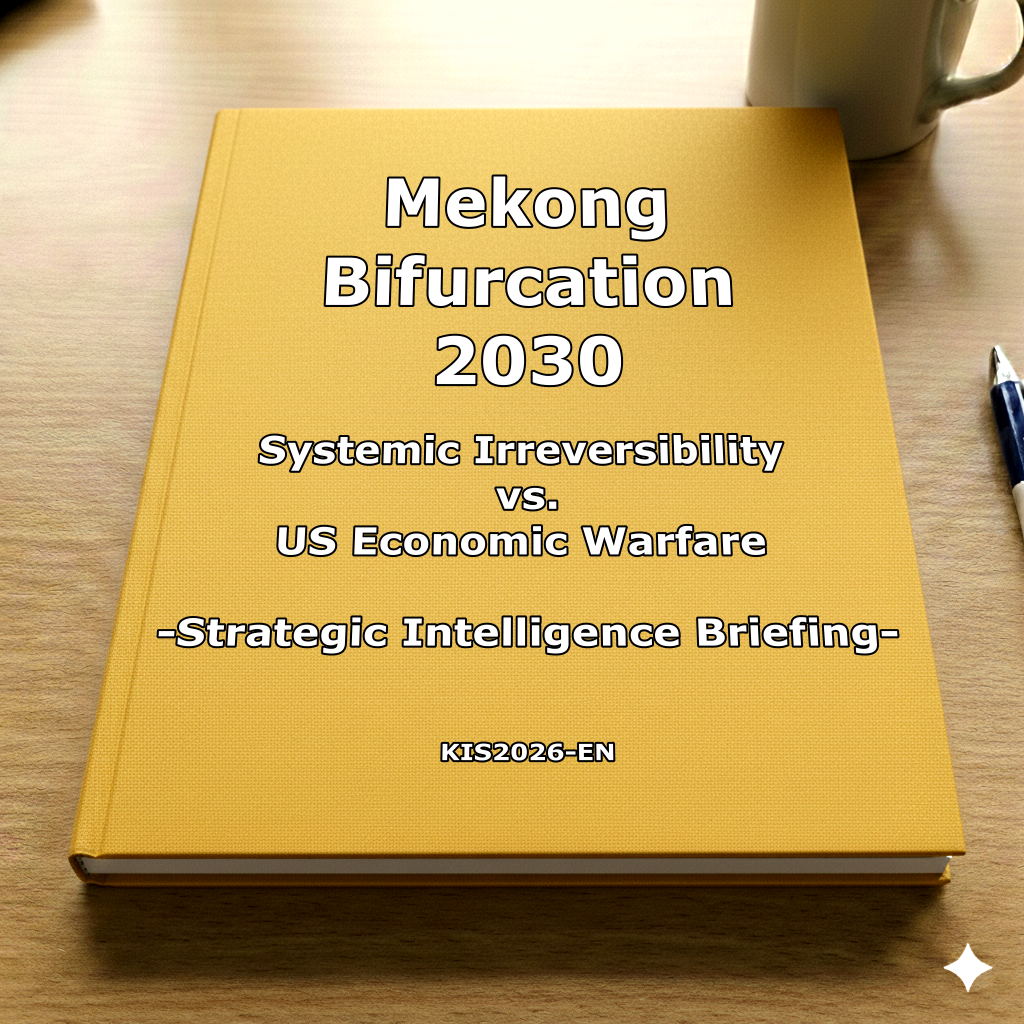

kis_US STRATEGY 2025-AMBITIONS, PLANS, AND THE REALIGNMENT OF SOUTHEAST ASIA-Jan26-EN
5.500,00$
US Strategy 2025: Southeast Asia Realignment An unvarnished analysis of American geopolitical maneuvering in the Mekong sub-region (2025-2030). This report examines the shift from security alliances to supply chain weaponization, the new 40% “transshipment” tariffs, and the fight for rare earth dominance in Laos. Essential intelligence for investors navigating the US-China decoupling.
PDF, 14 pages
Description
Title: US Strategy 2025: The Mekong Pivot & Supply Chain Weaponization
Subtitle: Ambitions, Plans, and the Realignment of Southeast Asia (2025–2030)
Southeast Asia faces a radical realignment. Under the new US administration, foreign policy has metamorphosed from liberal internationalism to hard, transactional realism . For investors and corporations in the region, the era of strategic ambiguity is over.
This intelligence report (14 pages) provides an unvarnished analysis of the new US strategy in the Mekong sub-region. We expose how Washington is leveraging trade tariffs, crime fighting, and “Soft Power” as weapons to roll back Chinese influence and enforce supply chain compliance .
What you will learn in this report:
-
The “Transshipment” Trap: Why a new 40% penalty tariff looms over the region and how the US is reversing the burden of proof for “China-Free” supply chains.
-
Vietnam as a “Stress Test”: Why the “Non-Market Economy” (NME) status remains in place and which sectors (Semiconductors vs. Solar) are considered political “Safe Havens” .
-
Asymmetric Warfare: How the “Scam Center Strike Force” is dismantling Chinese financial networks in Cambodia and Laos
-
Resource Warfare: The battle for heavy rare earth elements (HREE) in Laos and the push to break the Chinese monopoly.
-
Scenarios 2026-2028: From economic bifurcation to the potential collapse of tariff policies—we analyze the probabilities
-
Format: PDF (High-Level Strategic Paper) Language: English Author: Ralf G. Kuehn, KIS-Projects International
Reading Sample (Excerpt from Chapter 2.2):
The “Transshipment” Trap: 40% Penalty Tariffs as a Sword of Damocles
A central element of the new US strategy is the aggressive prosecution of “transshipment”—the practice of exporting Chinese goods to the US via third countries like Vietnam or Thailand to circumvent tariffs . The US administration has announced a 40% penalty tax on all goods identified as “transshipped”.
This effectively forces ASEAN governments to assume the role of US Customs, subjecting their own exporters to the strictest Rules of Origin (ROO) audits. The burden of proof has shifted: companies must now proactively prove their supply chain is not Chinese, rather than the US Customs proving the contrary.
This is driving a massive bifurcation of the industrial base in Southeast Asia. Manufacturers must now decide whether to produce for the US market (high compliance costs, no Chinese inputs) or for the rest of the world (Chinese inputs permitted).
Recommended Analysis Topics (on demand) – contact ur for further information
-
Deep Dive: Vietnam’s Semiconductor Roadmap 2030 – Analyzing actual capacities vs. ambitions in Assembly, Testing & Packaging (ATP) under the CHIPS Act and US subsidies.
-
The “Distressed Asset” Playbook: Sihanoukville – A guide for risk-tolerant investors: Identifying undervalued real estate and casino assets following the “Scam Center Strike Force” crackdown.
-
Laos Mining Monitor: Rare Earths & Critical Minerals – Mapping licensed extraction zones, Western players (like Canada Rare Earth Corp), and non-Chinese export routes.
-
Compliance Guide: Surviving the “Dirt to Shelf” Audit – A technical manual for Supply Chain Managers: How to document Rules of Origin (ROO) to avoid the 40% penalty tariffs.
-
The Energy Battlefield: Mekong Hydropower vs. LNG – Analyzing the US push to switch Vietnam and Thailand from Chinese coal to US LNG, and the opportunities for solar IPPs in Laos.
-
Thailand’s Balancing Act: The Gripen Deal & Chinese EVs – How Bangkok navigates between Chinese automotive investments (BYD) and US military interoperability.
-
Cybersecurity & Digital Sovereignty in ASEAN – US efforts for “Clean Networks” and opportunities for Western tech providers in banking and government sectors to replace Huawei/ZTE.
-
The Golden Triangle Shadow Economy Report – Investigating money flows, sanctioned actors (Zhao Wei), and the displacement of laundering routes due to US pressure .
-
Cambodia’s Succession: Hun Manet’s Realpolitik – A political profile: Is he a reformer or a new face for the old system? Implications for Western FDI and the Ream Naval Base.
-
ASEAN Grid 2040: The Business Case for Interconnectivity – Focusing on power trading between Laos, Thailand, and Singapore (JUMPP initiative) and investment in transmission infrastructure.


Reviews
There are no reviews yet.