

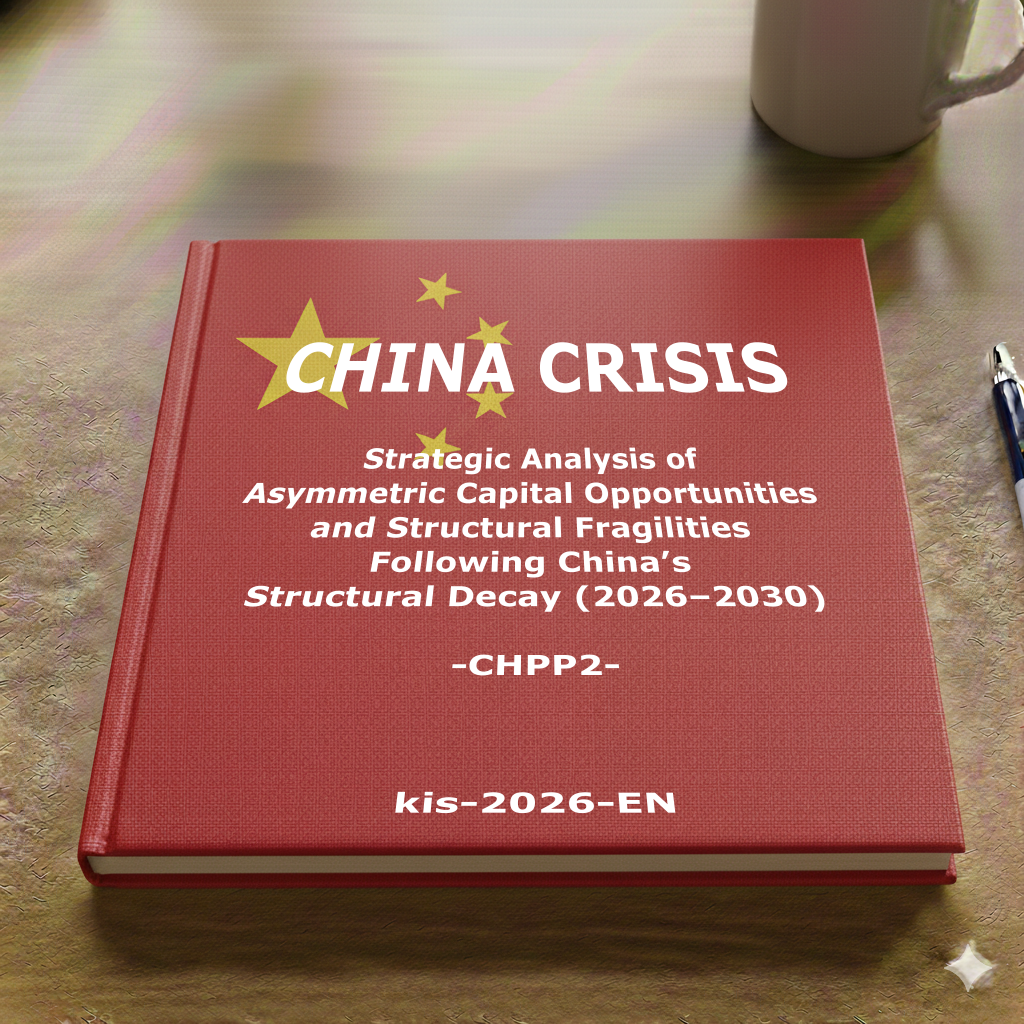

kis_PR China 2026: Macroeconomic Structural Failure Analysis-CHPP1-EN
12.500,00$
Focus: High-level systemic fragility assessment and structural failure point analysis of the People’s Republic of China in February 2026.
-
Format: Digital Strategic Brief (PDF)
-
Volume: 10 Pages of Deep-Vector Macro Analysis
-
Systemic Fragility: Quantitative audit of the “Zombie Trap” in Local Government Financing Vehicles (LGFVs) and the metastasis of the real-estate recession.
-
Demographic Compression: Analysis of the skill mismatch and workforce contraction threatening high-quality industrial modernization.
-
Tech Autarky Stress: Evaluation of the “Compute Supply Gap” and the fiscal strain of sanction-driven technological stagnation.
Description
Global decision-makers often rely on official growth narratives that mask the accelerating decay of China’s economic pillars. As of early 2026, the “Managed Decline” of the property sector has evolved into a full-scale balance sheet recession, while aggressive debt substitution programs have merely hardened systemic liabilities rather than resolving them.
Agitation: Relying on China’s 15th Five-Year Plan (2026-2030) as a guarantor of stability is a strategic error. The convergence of LGFV ROA falling below interest costs, a persistent consumption slump, and technological autarky creates a “Controlled Instability.” Investors and strategists who ignore the skill mismatch in the workforce or the fragility of the “Two-Speed” economy risk being blindsided by localized systemic failures.
Solution: This Systemic Fragility Assessment (CHPP1) provides the unvarnished data required to navigate the PRC’s economic realignment. It decomposes critical vectors—from fiscal integrity to tech autarky—offering specialized actors the “Failure Matrix” necessary to stress-test their China exposure and identify the true systemic failure points.
Insights into the Expertise (Reading Sample)
“The macroeconomic integrity of the PR China in February 2026 presents a picture of ‘controlled instability.’ Immediate liquidity crises have been averted through state intervention, but the structural roots—unprofitable local debt, a property-wealth concentration, and a demographic/skill mismatch—remain unaddressed. China walks a fine line between a successful transition to an AI-powered superpower and long-term stagnation cemented by debt and demographic decline. The LGFV liability transfer program has not eliminated the ‘Zombie Trap’; it has merely nationalized the erosion of future investment capacity. As consumption remains stagnant due to the negative wealth effect of asset deflation, the PRC’s vulnerability to external shocks—specifically tariffs—is reaching a critical threshold.”
10 Strategic Analysis & Application Proposals
-
LGFV “Zombie Trap” Audit: Evaluate the impact of debt-to-equity swaps on future municipal investment capacity and local credit availability.
-
Asset Deflation Hedging: Adjust consumption-led growth projections based on the negative wealth effect of the prolonged real estate failure.
-
Skill Mismatch Modeling: Stress-test industrial modernization targets against the accelerating demographic compression and labor supply shock.
-
Compute Supply Gap Analysis: Analyze the operational efficiency loss caused by technological stagnation relative to the global frontier.
-
Two-Speed Economy Risk: Differentiate exposure between the robust export-oriented sectors and the failing domestic consumption market.
-
Fiscal Strain Benchmarking: Monitor the rising energy over-utilization costs as a byproduct of sanction-driven industrial inefficiencies.
-
Social Tension Monitoring: Track the delta between productivity expectations and stagnant wages to predict potential labor unrest.
-
Sanction Sensitivity Mapping: Quantify the systemic risk posed by increased trade tariffs on China’s high-tech industrial output.
-
Consumption Slump Mitigation: Pivot away from mass-market consumer exposure to specialized state-driven procurement niches.
-
15th Five-Year Plan Stress-Test: Validate the viability of the 2026-2030 realignment goals against the current fiscal and demographic reality.


Reviews
There are no reviews yet.